

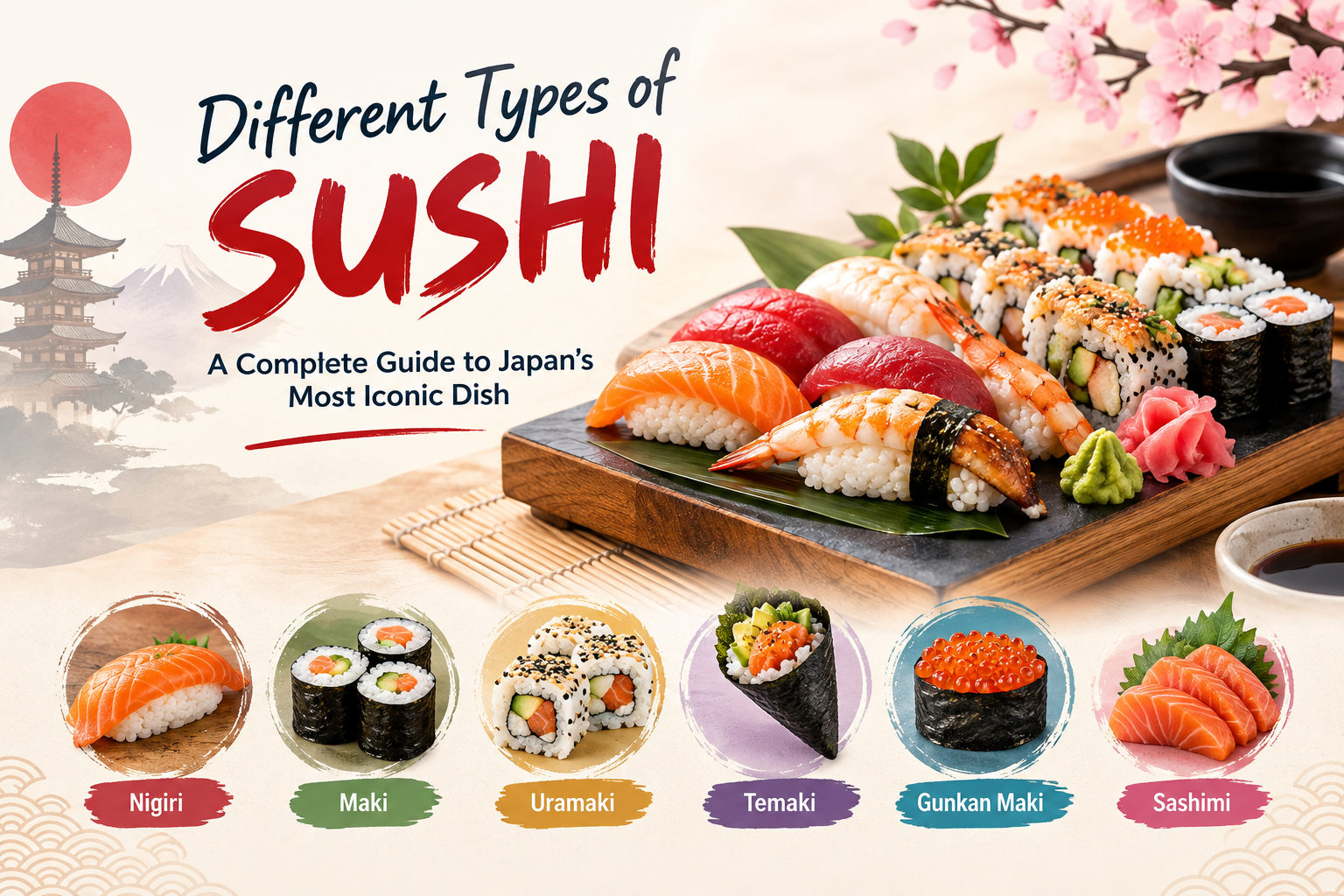
Ask ten people what “sushi” means and most will say raw fish. That’s actually a myth. The one non-negotiable ingredient in every type of sushi is shari — vinegared, seasoned rice. Fish is common, but it’s optional; rice is not. Once you understand that single rule, the whole confusing menu of Japanese restaurant names — nigiri, maki, uramaki, temaki, gunkan, chirashi — starts to make a lot more sense.
This guide breaks down every major type of sushi, how each one is made, how it differs from its cousins, and how to eat it like you know what you’re doing.
A Quick History: Sushi Didn’t Start as a Delicacy
Sushi wasn’t invented as fine dining — it began as a way to keep fish from spoiling.
The earliest form, called narezushi, originated in Southeast Asia around the 2nd century BCE. Fishermen packed salted fish in fermented rice for months at a time; the fermentation preserved the fish, and the rice itself was usually thrown away before eating. This technique traveled along trade routes into China and eventually reached Japan by around the 8th century.
Over the following centuries, the Japanese gradually shortened the fermentation process and started eating the rice along with the fish, giving rise to intermediate styles known as han-narezushi. By the 17th century, cooks in Japan discovered that adding rice vinegar directly to freshly cooked rice mimicked the tang of fermentation almost instantly — no months of waiting required. This innovation, called hayazushi (“fast sushi”), set the stage for the sushi we recognize today.
The final leap came in the 1820s in Edo (modern-day Tokyo), when a food stall owner named Hanaya Yohei began pressing small mounds of vinegared rice by hand and topping them with a slice of fresh, local seafood. This style, known as Edomae-zushi (“sushi from in front of Edo,” referring to Tokyo Bay), was essentially the birth of nigiri sushi — and it was originally sold as cheap, fast street food for working-class city dwellers, not the luxury item it’s often treated as today.
The Core Types of Sushi
1. Nigiri
Nigiri is the style most people picture when they think “classic sushi.” It’s made by pressing a small oblong mound of vinegared rice by hand, then draping a single slice of fish, shellfish, or occasionally a cooked topping over it — often with a tiny smear of wasabi tucked between the rice and the fish.
Common nigiri toppings include:
- Maguro (tuna)
- Sake (salmon)
- Hamachi (yellowtail)
- Ebi (shrimp, usually cooked)
- Unagi (freshwater eel, always cooked and glazed)
- Tamago (a slightly sweet rolled omelet)
How to eat it: pick it up with your fingers (this is traditionally acceptable, even in nice restaurants), and dip the fish side — not the rice — lightly into soy sauce. Dipping rice-first oversalts the piece and often causes it to fall apart.
2. Sashimi (Technically Not Sushi)
Sashimi gets lumped in with sushi on almost every menu, but it doesn’t actually qualify — because it has no rice. It’s simply thin, precisely cut slices of raw fish or seafood, served on their own with soy sauce, wasabi, and pickled ginger on the side.
Because there’s no rice to balance the flavor, sashimi lives or dies on the quality and freshness of the fish itself, which is why it’s typically made from the same sashimi-grade cuts used for nigiri.
3. Maki (Rolled Sushi)
Maki means “to roll” in Japanese, and it refers to any sushi where rice and fillings are rolled inside a sheet of nori (dried seaweed) using a bamboo mat (makisu), then sliced into rounds. The nori is on the outside, the fillings are in the center, and the whole roll is usually cut into six or eight pieces.
Maki has its own sub-varieties based on size and content:
- Hosomaki — thin rolls with just one filling (a classic example is kappa maki, a simple cucumber roll, or tekka maki, tuna).
- Futomaki — thick rolls packed with multiple fillings — often vegetables, egg, and fish together — giving a colorful cross-section when sliced.
- Uramaki — the “inside-out roll,” where the rice is on the outside and the nori is hidden inside, often coated with sesame seeds or fish roe. This style wasn’t traditional at all — it was invented in Los Angeles in the 1960s specifically to appeal to Western diners who weren’t used to seeing seaweed on the outside of their food. Today it’s the most common sushi style in the United States, and it’s the base for most of the elaborate “special rolls” you’ll see on Western sushi menus, such as:
- California Roll — crab (or imitation crab), avocado, and cucumber
- Spicy Tuna Roll — chopped raw tuna mixed with spicy mayo or sriracha
- Dragon Roll — shrimp tempura and cucumber inside, topped with sliced avocado arranged to resemble dragon scales
- Rainbow Roll — a California roll topped with an assortment of colorful sliced fish
4. Temaki (Hand Rolls)
Temaki is sushi rolled by hand into a cone shape, rather than with a bamboo mat — think of it as a sushi ice cream cone. The nori is on the outside, and rice and fillings are stuffed inside, with the wide end left slightly open. Because it’s assembled quickly and eaten immediately (before the nori goes soft), temaki is a popular do-it-yourself party format — guests can build their own with whatever fillings they like.
5. Gunkan-maki (“Battleship Roll”)
Gunkan-maki solves a practical problem: how do you serve loose, soft, or delicate toppings — like fish roe, sea urchin, or finely chopped ingredients — that would fall off a regular nigiri or slide out of a maki roll? The answer is to wrap a strip of nori around the outside of an oval mound of rice, forming a little cup, and then pile the topping on top. The shape is said to resemble a small warship, hence the name. It’s the standard way to serve ikura (salmon roe) and uni (sea urchin).
6. Chirashi (Scattered Sushi)
Chirashi literally means “scattered.” Instead of being rolled or hand-pressed, it’s served as a bowl of vinegared rice topped with an artful scattering of sashimi-grade fish, vegetables, and garnishes. There’s no fixed recipe — chirashi is often treated as a creative, seasonal dish, and it’s a popular way for chefs (and home cooks) to showcase whatever good fish is available that day. Because it requires no rolling technique, it’s also one of the easiest sushi styles to make at home.
7. Oshizushi (Pressed Sushi)
Oshizushi hails from the Kansai region of Japan (around Osaka), a strong contrast to Edomae-zushi’s Tokyo origins. It’s made using a rectangular wooden mold called an oshibako: a layer of rice is topped with cured or cooked fish (mackerel is a traditional favorite), pressed firmly, then removed from the mold and sliced into neat, uniform blocks. The result looks almost like sushi “tiles” rather than individual pieces, and it holds together well, which historically made it useful for travel and gift-giving.
8. Inarizushi
Inarizushi skips fish altogether. It’s simply vinegared rice stuffed into a pouch of sweet, seasoned fried tofu skin (aburaage). It’s inexpensive, vegetarian, and a common lunchbox or snack item in Japan rather than a restaurant showpiece — but it’s a genuine, traditional type of sushi by the “vinegared rice” definition.
9. Temarizushi
Temari sushi is a small, ball-shaped sushi made by pressing rice and a topping into a round shape using plastic wrap, rather than the oblong shape of nigiri. It’s known for being visually delicate and colorful, and is often served at celebrations in Japan.
10. Narezushi — The Ancestor of It All
Still made in small quantities today, particularly in Shiga Prefecture (funazushi, made with a local carp), narezushi is the original fermented dish that started this whole culinary lineage more than two thousand years ago. It has a strong, sour, pungent flavor from months of lacto-fermentation and bears little resemblance to modern sushi — but without it, none of the other types on this list would exist.
Sushi vs. Sashimi vs. Maki: The Quick Cheat Sheet
| Type | Rice? | Seaweed? | Shape |
|---|---|---|---|
| Nigiri | Yes | No (usually) | Hand-pressed mound with fish on top |
| Sashimi | No | No | Sliced raw fish only |
| Maki | Yes | Outside, wrapped around filling | Rolled tube, sliced into rounds |
| Uramaki | Yes | Hidden inside | Rolled tube, rice visible outside |
| Temaki | Yes | Outside | Hand-rolled cone |
| Gunkan-maki | Yes | Wrapped around edge | Cup-shaped with loose topping on top |
| Chirashi | Yes | Optional garnish | Bowl, scattered toppings |
A Note on Raw Fish Safety
Not all fish sold at a regular grocery store is safe to eat raw. Fish intended for raw consumption is typically flash-frozen to specific temperatures to kill parasites, a process usually referred to as “sushi-grade” handling (though this isn’t an official regulated term everywhere). If you’re making sushi at home with raw fish, buy it specifically from a reputable fishmonger or sushi supplier who can confirm it’s been properly handled for raw consumption — this matters far more for food safety than any technique in the kitchen.
How to Eat Sushi Like You Know What You’re Doing
- Dip fish-side down, not rice-side, to avoid oversalting and keep the rice from falling apart.
- Eat nigiri in one bite — halving it collapses the balance the chef built into the piece.
- Use ginger as a palate cleanser between different types of fish, not as a topping on the sushi itself.
- Save wasabi judgment — many nigiri already have wasabi tucked under the fish, so taste before adding more.
- Eat hand rolls (temaki) immediately — they’re designed to be eaten while the nori is still crisp, not saved for later.
Final Thoughts
Sushi looks intimidating on a menu mostly because of terminology, not complexity. Underneath all the Japanese names, there are really only a handful of underlying techniques — pressed, rolled, hand-rolled, wrapped, pressed-in-a-mold, or scattered — built around one unchanging ingredient: vinegared rice. Once you can recognize nigiri from maki and gunkan from temaki, a Japanese sushi menu stops being a guessing game and starts being a genuinely fun way to explore one of the world’s most refined cuisines.