

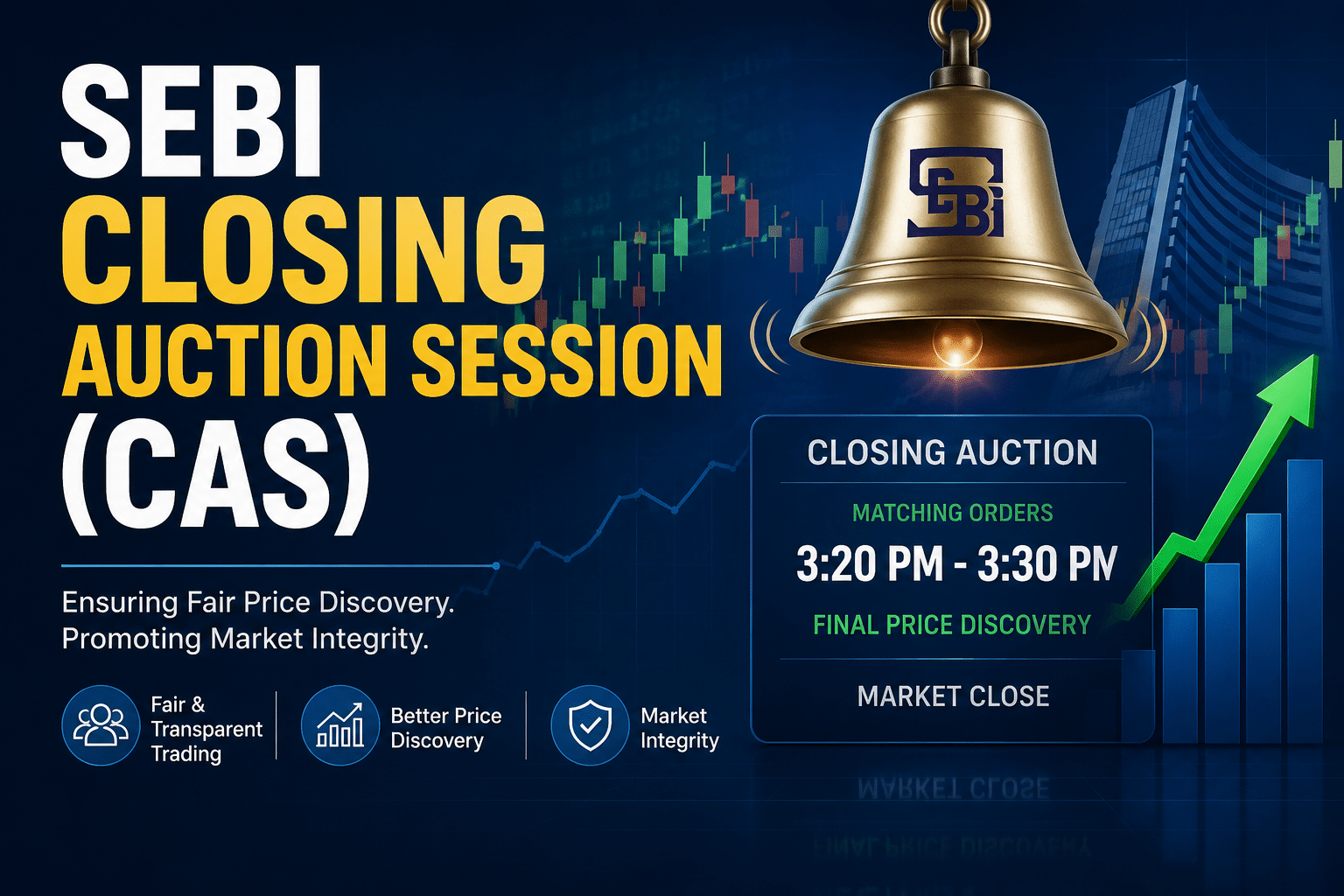
If you trade in Reliance, HDFC Bank, Infosys, TCS, or any other stock that has futures and options contracts, your last 20 minutes of trading are about to look completely different. From August 3, 2026, SEBI is replacing the way closing prices get calculated for these stocks with a new mechanism called the Closing Auction Session, or CAS.
We have seen a lot of confusion around this change on trading forums and among our own clients at Techolic – some investors think the market is closing early, others think it only affects large traders, and a few think it applies to every stock on the exchange. None of that is fully accurate. In this article, we break down exactly what the Closing Auction Session is, why SEBI introduced it, which stocks it applies to, the exact minute-by-minute timeline, and what it practically means for your trading and investing routine.
What Exactly Is the Closing Auction Session (CAS)?
The Closing Auction Session is a new, dedicated window at the end of the trading day where the exchange collects buy and sell orders for a short period and then matches them all at once to arrive at a single price — instead of continuously matching trades throughout that window the way normal trading works.
Think of it like a silent bidding round. Rather than prices moving order by order as trades happen live, everyone submits their orders during a fixed window, and the exchange computes the one price at which the maximum number of shares can be matched between buyers and sellers. That single price becomes the official closing price of the stock for the day.
This is not a new concept globally. Exchanges like the London Stock Exchange, Euronext, Nasdaq, and the Singapore Exchange have used closing auctions for years specifically because they produce a more reliable, harder-to-manipulate closing price than a simple average of the last few minutes of trades. SEBI’s Closing Auction Session brings Indian markets in line with this global practice.
Why Did SEBI Introduce the Closing Auction Session?
To understand why this matters, you need to understand how closing prices are calculated today.
Right now, the official closing price of a stock is the Volume Weighted Average Price (VWAP) of all trades executed during the last 30 minutes of continuous trading — between 3:00 PM and 3:30 PM. This method has worked for years, but it has one well-known weakness: a large order placed in the final few minutes can pull the average price up or down in a way that doesn’t reflect genuine market consensus. Since the closing price is used for derivatives settlement, index computation, and mutual fund NAV calculation, even small distortions here can ripple across the entire market.
SEBI’s stated reasoning for introducing the Closing Auction Session includes:
- Stronger price discovery — aggregating all end-of-day interest into a single pool rather than scattered continuous trades
- Reduced manipulation risk — a single large order can no longer single-handedly swing the VWAP in the last few minutes
- Better execution for large orders — institutional investors, mutual funds, and index funds rebalancing their portfolios get a fairer, more transparent price
- Greater transparency — the auction-based equilibrium price mechanism makes the process of arriving at the closing price more visible and predictable
Since the closing price directly feeds into derivatives settlement, benchmark index values, and mutual fund NAVs, a more robust price discovery process benefits every investor — even those who never trade directly in the futures and options segment.
Which Stocks Are Covered Under the Closing Auction Session?
This is the single biggest source of confusion, so let’s be direct about it: CAS does not apply to every stock listed on NSE or BSE from day one.
SEBI is rolling this out in a phased manner:
- Phase 1 (from August 3, 2026): CAS applies only to stocks that have active Futures & Options (F&O) contracts — this covers most large-cap and actively traded mid-cap names such as Reliance Industries, HDFC Bank, ICICI Bank, Infosys, TCS, and several hundred other F&O-enabled stocks
- Remaining stocks (no F&O contracts): These continue with the existing VWAP-based closing price method, unchanged, until SEBI notifies further phases
So if you primarily invest in small-cap or micro-cap stocks that don’t have derivative contracts, nothing changes for you right now. If you regularly trade in large or liquid mid-cap names, this change affects you directly starting August 3, 2026.
The Exact Timeline: How a Trading Day Changes for F&O Stocks
This is where most of the practical confusion lies, so let’s walk through it minute by minute for stocks that fall under CAS.
9:15 AM to 3:15 PM — Normal continuous trading. Nothing changes here. The market opens exactly as it does today, and trading proceeds normally right up until 3:15 PM — that’s 15 minutes earlier than the current 3:30 PM cutoff for continuous trading.
3:15 PM to 3:20 PM — Reference price calculation and transition into CAS. Continuous trading stops for CAS-eligible stocks. The exchange uses the VWAP of trades from the preceding 3:00 PM to 3:15 PM window as the reference price, which anchors the auction that follows. Exchanges also apply a price band around this reference price during the auction window to prevent extreme, disorderly price swings.
3:20 PM to 3:25 PM — Order entry, both limit and market orders allowed. This is when you can freely place, modify, or cancel your CAS orders.
3:25 PM to 3:30 PM — Restricted order entry. Only limit orders can still be placed, modified, or cancelled. Market orders can no longer be modified or cancelled. Somewhere in the last two minutes of this window — between 3:28 PM and 3:30 PM — the exchange randomly and automatically freezes order entry. This randomisation is deliberate: it stops traders from timing their final order to the exact last second to game the auction.
3:30 PM to 3:35 PM — Order matching. The exchange matches all collected buy and sell orders at the single equilibrium price that allows the maximum number of shares to change hands. This becomes the official closing price for the stock.
3:35 PM to 3:40 PM — Derivatives segment winds down. Futures and options trading continues live for another 10 minutes after CAS order entry ends, closing at 3:40 PM — a 10-minute extension from the current 3:30 PM cutoff.
3:50 PM to 4:00 PM — Post-close session. Once the new closing price is finalised, a 10-minute post-close window opens where you can still execute trades at the confirmed closing price.
For stocks without F&O contracts, none of this applies yet — they continue trading normally until 3:30 PM, with the closing price still calculated as the VWAP of the 3:00 PM to 3:30 PM window.
What Happens to F&O (Derivatives) Trading?
If you trade futures and options, here’s the good news: your segment is not shrinking. In fact, it’s getting slightly longer. The derivatives segment now closes at 3:40 PM instead of 3:30 PM, a 10-minute extension designed to keep F&O trading synchronised with the new cash market closing process. Your positions, margins, and strategies in the F&O segment are unaffected by CAS itself — CAS only changes how the cash market closing price is discovered, which in turn feeds into derivatives settlement calculations.
What Orders Are Allowed During CAS?
Only two order types are permitted during the Closing Auction Session: limit orders and market orders. Two commonly used order types are explicitly not allowed:
- Stop-loss orders — any pending stop-loss orders on CAS-eligible stocks are automatically cancelled as trading transitions from continuous mode into the auction
- Iceberg orders — these, which display only part of the total order quantity, are also not permitted during CAS
If you routinely place stop-loss orders that sit active through the 3:15 PM to 3:30 PM window on F&O stocks, this is the single most important practical change to be aware of. Your stop-loss will not carry through into the auction — you’ll need to plan your exits before 3:15 PM or use fresh limit/market orders within the CAS window itself.
How Does This Affect Retail Investors, SIP Investors, and Mutual Fund Holders?
Even if you never trade near market close, the Closing Auction Session touches your portfolio in indirect ways:
- Mutual fund NAV accuracy: Since fund NAVs are calculated using closing prices, a more robust price discovery process means your fund’s NAV better reflects genuine market value rather than a price skewed by a last-minute large order
- Index fund and ETF investors: Index computation relies on closing prices too, so passive fund investors benefit from tighter tracking against the actual benchmark
- Delivery-based investors: If you invest for the long term and don’t trade near the close, your day-to-day experience barely changes — you can still buy and sell throughout the day as usual
- Active and intraday traders: This is where the real adjustment happens. If your strategy involves trading in the final 15-20 minutes, placing stop-losses that run through market close, or squaring off intraday positions right at close on F&O stocks, you need to revisit your execution timing
Common Mistakes and Confusions to Avoid
- Thinking the market closes early. It doesn’t. Continuous trading for CAS stocks stops at 3:15 PM, but the trading day effectively extends to 4:00 PM once you count the auction, derivatives close, and post-close session
- Assuming CAS applies to all stocks. It only applies to F&O-eligible stocks in Phase 1. Everything else continues on the existing VWAP method for now
- Forgetting that stop-loss orders get cancelled. Traders who rely on stop-loss orders sitting through market close on F&O stocks need a new plan for the 3:15 PM onward window
- Confusing CAS with the pre-open auction session. These are two separate mechanisms. The revised pre-open auction session comes into effect later, from September 7, 2026, and governs how prices are set at market open, not close
- Assuming F&O trading is cut short. Derivatives trading actually gets 10 extra minutes, closing at 3:40 PM instead of 3:30 PM
CAS vs the Old VWAP Method: Quick Comparison
Price discovery method: Old method uses volume-weighted average of trades over 30 minutes; CAS uses a single auction-matched equilibrium price over a 20-minute window.
Continuous trading cutoff: Old method runs continuous trading until 3:30 PM; CAS-eligible stocks stop continuous trading at 3:15 PM.
Vulnerability to large last-minute orders: Old method can see the closing price shift meaningfully from one large order; CAS pools all orders together before matching, reducing this risk.
Order types allowed near close: Old method allows all standard order types including stop-loss right up to 3:30 PM; CAS restricts orders to limit and market only, with stop-loss and iceberg orders cancelled.
Applicability: Old method applies to all stocks currently; CAS applies only to F&O-eligible stocks in Phase 1, with other stocks continuing on the old method.
What Should You Do Before August 3, 2026?
- Check whether the stocks you actively trade have F&O contracts — if they do, they fall under CAS from day one
- Review any stop-loss orders you typically leave running through market close on these stocks and plan an alternative exit strategy
- If you use intraday or MIS products, check with your broker whether their auto square-off timings have been adjusted to align with the new 3:15 PM cutoff
- If you’re a long-term, delivery-based investor, there’s genuinely little you need to do differently — your buying and selling experience through the trading day remains the same
- Keep an eye on your broker’s app or platform notifications closer to August 3, since most brokers will flag CAS-eligible stocks directly in the order window
At Techolic, we’ll continue tracking how this rollout plays out in practice and will update our readers if SEBI extends CAS to additional stock categories in future phases.
Frequently Asked Questions
What is the Closing Auction Session (CAS) in simple terms?
It’s a new SEBI-mandated process where, instead of calculating a stock’s closing price as an average of the last 30 minutes of trades, the exchange collects orders during a fixed 20-minute window and matches them at a single price to determine the official close.
When does the Closing Auction Session start in India?
The Closing Auction Session comes into effect from August 3, 2026, for stocks that have active Futures & Options contracts.
Does CAS apply to all stocks on NSE and BSE?
No. In Phase 1, it applies only to F&O-eligible stocks. Stocks without derivative contracts continue using the existing VWAP-based closing price method until SEBI notifies further changes.
Does the stock market close earlier now?
No. Continuous trading for CAS stocks stops at 3:15 PM instead of 3:30 PM, but the overall cash market process — including the auction and post-close session — now extends to 4:00 PM.
Will my stop-loss order still work near market close?
Not during the CAS window. Stop-loss orders on CAS-eligible stocks are automatically cancelled as trading transitions from continuous mode into the auction at 3:15 PM. You’ll need to plan exits before this cutoff or use fresh limit or market orders within the auction window.
Does CAS affect futures and options trading?
Not directly. The derivatives segment continues trading until 3:40 PM, 10 minutes later than the current close, to stay synchronised with the new cash market process.
How does CAS affect mutual fund investors?
Since mutual fund NAVs and benchmark indices are calculated using closing prices, a more accurate closing price discovery process indirectly improves the reliability of the NAVs you see, especially for index funds and ETFs tracking F&O-eligible large-cap stocks.