

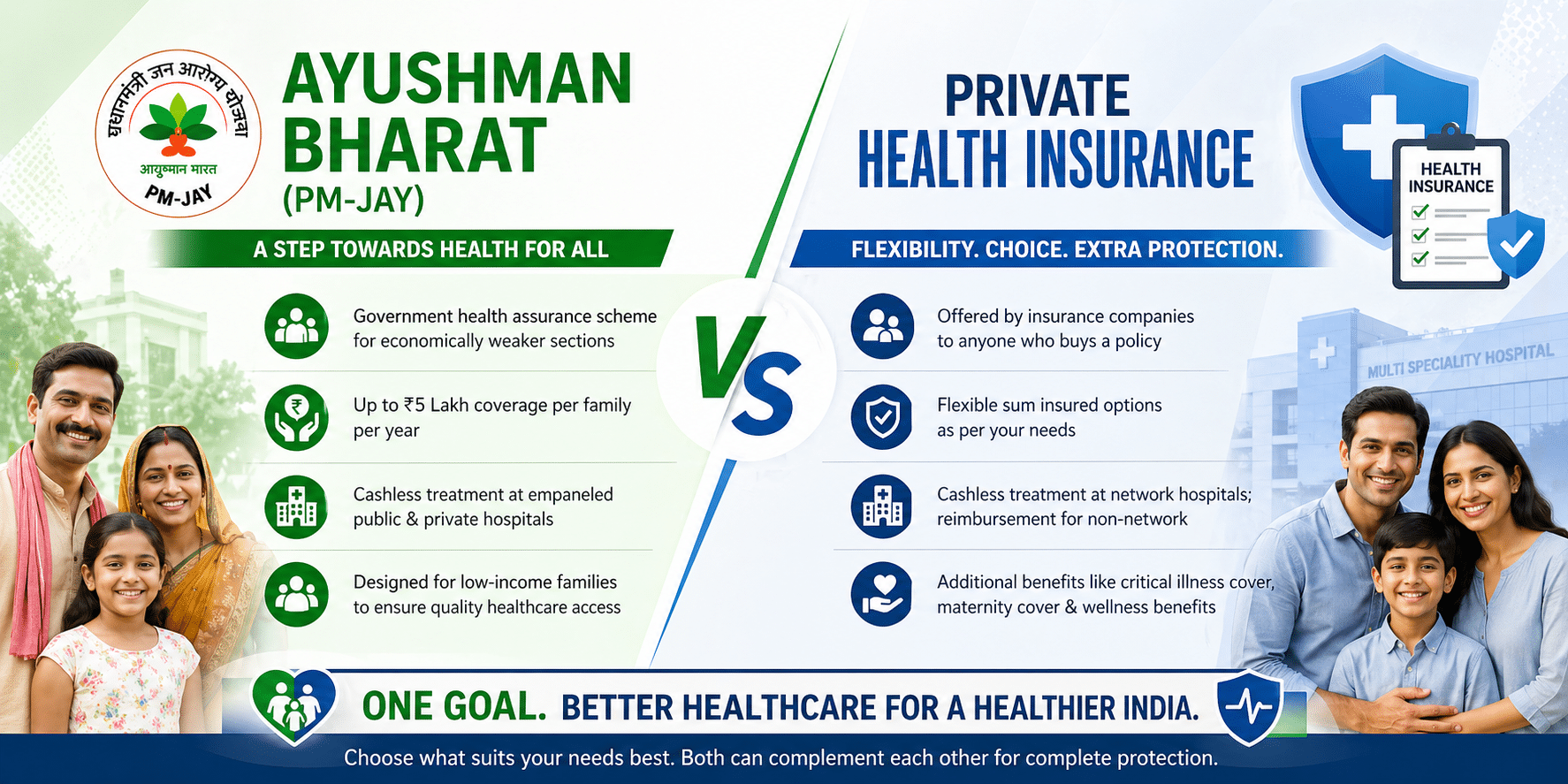
Every year, millions of Indian families face a tough question after a medical emergency: will our health coverage actually be enough? With two very different options on the table — the government’s Ayushman Bharat Pradhan Mantri Jan Arogya Yojana (PMJAY) and private health insurance — understanding what each truly offers can mean the difference between financial security and a devastating hospital bill.
This guide breaks down both options side by side, so you can make the right call for your family’s situation.
| Quick answer: Ayushman Bharat is a lifeline for lower-income families but has hard eligibility limits. Private health insurance offers broader coverage, flexibility, and higher coverage limits — but comes at a cost. For many middle-income families, the best answer may be both. |
What is Ayushman Bharat (PMJAY)?
Launched in 2018, Ayushman Bharat — Pradhan Mantri Jan Arogya Yojana — is the world’s largest government-funded health insurance scheme. It covers approximately 55 crore beneficiaries from economically vulnerable families across India, making it a genuine safety net for those who previously had no health coverage at all.
Key features of Ayushman Bharat
- Coverage of up to ₹5 lakh per family per year for secondary and tertiary hospitalisation
- Completely free for eligible beneficiaries — no premium to pay
- Covers pre-existing conditions from day one (no waiting period)
- Cashless treatment at over 25,000 empanelled government and private hospitals
- Covers 1,949 medical and surgical procedures including cancer, cardiac, and orthopaedic care
- Family size is not capped — the entire family is covered under one policy
Who qualifies?
Eligibility is based on the Socio-Economic Caste Census (SECC) 2011 data. Broadly, you qualify if your family:
- Is listed in SECC 2011 as a deprived rural household
- Belongs to specific occupational categories (construction workers, rag pickers, domestic workers, etc.)
- Has an annual income below ₹1.8 lakh in some state extensions
You can check your eligibility at pmjay.gov.in or by calling the helpline: 14555.
What is private health insurance?
Private health insurance is a policy you purchase from an insurance company — such as Star Health, HDFC ERGO, Niva Bupa, or ICICI Lombard — to cover hospitalisation costs, surgeries, and sometimes outpatient expenses. Unlike Ayushman Bharat, it is available to anyone regardless of income, and you pay an annual premium in exchange for coverage.
Key features of private health insurance
- Coverage ranging from ₹3 lakh to ₹1 crore+ depending on the plan
- Individual and family floater plans available
- Wide network of hospitals including top-tier private hospitals
- Optional riders for critical illness, personal accident, OPD, and maternity
- Tax deduction under Section 80D of the Income Tax Act
- Policy portability — switch insurers without losing benefits
What does it typically cost?
Premiums depend on your age, sum insured, and the insurer. As a rough guide for a family of four:
- Basic plan (₹5 lakh cover): ₹10,000–15,000/year
- Mid-range plan (₹10 lakh cover): ₹15,000–25,000/year
- Comprehensive plan (₹25 lakh+ cover): ₹25,000–50,000+/year
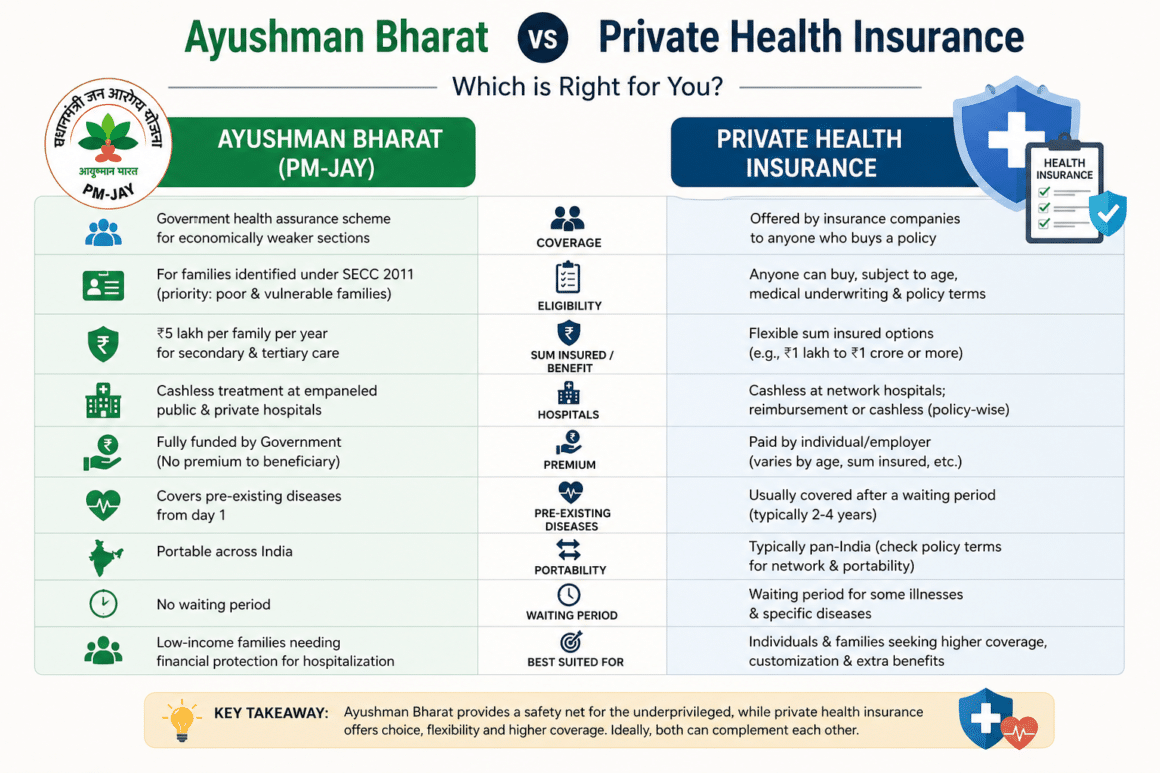
Side-by-side comparison
| Feature | Ayushman Bharat (PMJAY) | Private health insurance |
| Eligibility | BPL families, annual income <₹1.8L | Anyone — any income level |
| Premium cost | Free (govt. funded) | ₹5,000–₹25,000+ per year |
| Coverage amount | Up to ₹5 lakh/family/year | ₹3 lakh to ₹1 crore+ |
| Hospitals covered | Govt. + empanelled private | Wide network, incl. top hospitals |
| Pre-existing diseases | Covered from day 1 | 2–4 year waiting period |
| Individual cover | Family floater only | Individual or family floater |
| Critical illness | Limited | Available as add-on |
| Cashless claims | Yes (empanelled hospitals) | Yes (network hospitals) |
| Portability | Only within scheme | Full portability across insurers |
| OPD / medicines | Not covered | Optional OPD riders available |
Where Ayushman Bharat falls short
Despite being a landmark scheme, Ayushman Bharat has real limitations that eligible families should be aware of:
- 1. Hard income eligibility cutoff
If your family’s income slightly exceeds the threshold, you are excluded entirely — even if you cannot comfortably afford private insurance.
- 2. Limited to hospitalization only
Outpatient consultations, medicines, diagnostics, and preventive care are not covered. A chronic condition requiring regular doctor visits and medication can still drain your savings.
- 3. Hospital network quality varies
While many good private hospitals are empanelled, the best super-speciality hospitals in metro cities are often not on the list. For complex procedures, you may face limitations.
- 4. No individual coverage
The ₹5 lakh limit applies per family per year — not per person. If two family members need hospitalisation in the same year, you share the same pool.
- 5. Geography-dependent quality
The scheme works far better in some states than others. Implementation, hospital quality, and claim processing varies significantly by state.
Where private health insurance falls short
Private insurance is not without its own problems:
- 1. Waiting periods for pre-existing diseases
Most private insurers impose a 2–4 year waiting period before covering pre-existing conditions like diabetes, hypertension, or thyroid disorders. This is a major gap for older buyers.
- 2. Premium increases with age
Premiums rise sharply as you get older — what costs ₹10,000/year at 30 may cost ₹40,000+ at 60. Buying early locks in lower premiums.
- 3. Claim denials and sub-limits
Policies often have sub-limits on room rent, ICU charges, or specific procedures. A claim denial due to fine print can be financially devastating.
- 4. Co-payment clauses for senior citizens
Many insurers apply a co-payment clause (10–20% of the bill) for policyholders over 60, meaning you still pay a chunk out of pocket.
Which is better for your family?
| The honest answer: it depends entirely on your income level, health needs, and risk appetite. Here is a simple framework to decide. |
Choose Ayushman Bharat if:
- Your family is listed in the SECC 2011 database and eligible
- You cannot afford private insurance premiums
- Your primary concern is large hospitalisation bills, not routine care
- You live in a state with good PMJAY implementation (e.g., Karnataka, Gujarat, Tamil Nadu)
Choose private health insurance if:
- Your income exceeds Ayushman Bharat eligibility thresholds
- You want flexibility to choose any hospital in India
- You need higher coverage (₹10 lakh+) for your family
- You want coverage for critical illness, maternity, or OPD expenses
- You want to claim Section 80D tax deductions on premiums
Consider both if:
- You are eligible for Ayushman Bharat but can also afford a top-up private policy
- You want Ayushman Bharat as the base layer and private insurance as a super top-up for higher claims
The smart strategy: layer them together
For families who qualify for Ayushman Bharat but also have some disposable income, the smartest move is to use both. Here is how:
- Use Ayushman Bharat as your primary cover for hospitalisation at empanelled hospitals
- Buy a super top-up plan (not a regular top-up) that kicks in after a deductible (e.g., ₹5 lakh) is crossed
- A super top-up of ₹20 lakh with a ₹5 lakh deductible can cost as little as ₹3,000–5,000/year for a family
- This combination gives you ₹25 lakh in total coverage for a very low out-of-pocket cost
Tips before buying private health insurance in India
- Buy young: premiums are significantly lower if you start in your 20s or 30s
- Check the claim settlement ratio of the insurer (aim for 95%+)
- Avoid plans with room rent sub-limits or co-payment clauses where possible
- Disclose all pre-existing conditions honestly to avoid future claim rejections
- Choose a family floater only if family members are similar in age; older families may benefit from individual plans
- Read the exclusions list carefully before signing
The bottom line
Ayushman Bharat is one of the most ambitious social welfare schemes India has ever launched — and for eligible families, it is an absolute must-use. But it was designed as a safety net for the most vulnerable, not as a comprehensive health solution for all Indians.
If you are in the middle-income bracket, private health insurance is non-negotiable. Medical inflation in India runs at 14–18% per year, and a single major illness can wipe out years of savings without adequate cover.
The best approach: know your eligibility, understand your coverage gaps, and build a health insurance strategy that leaves no family member unprotected.