

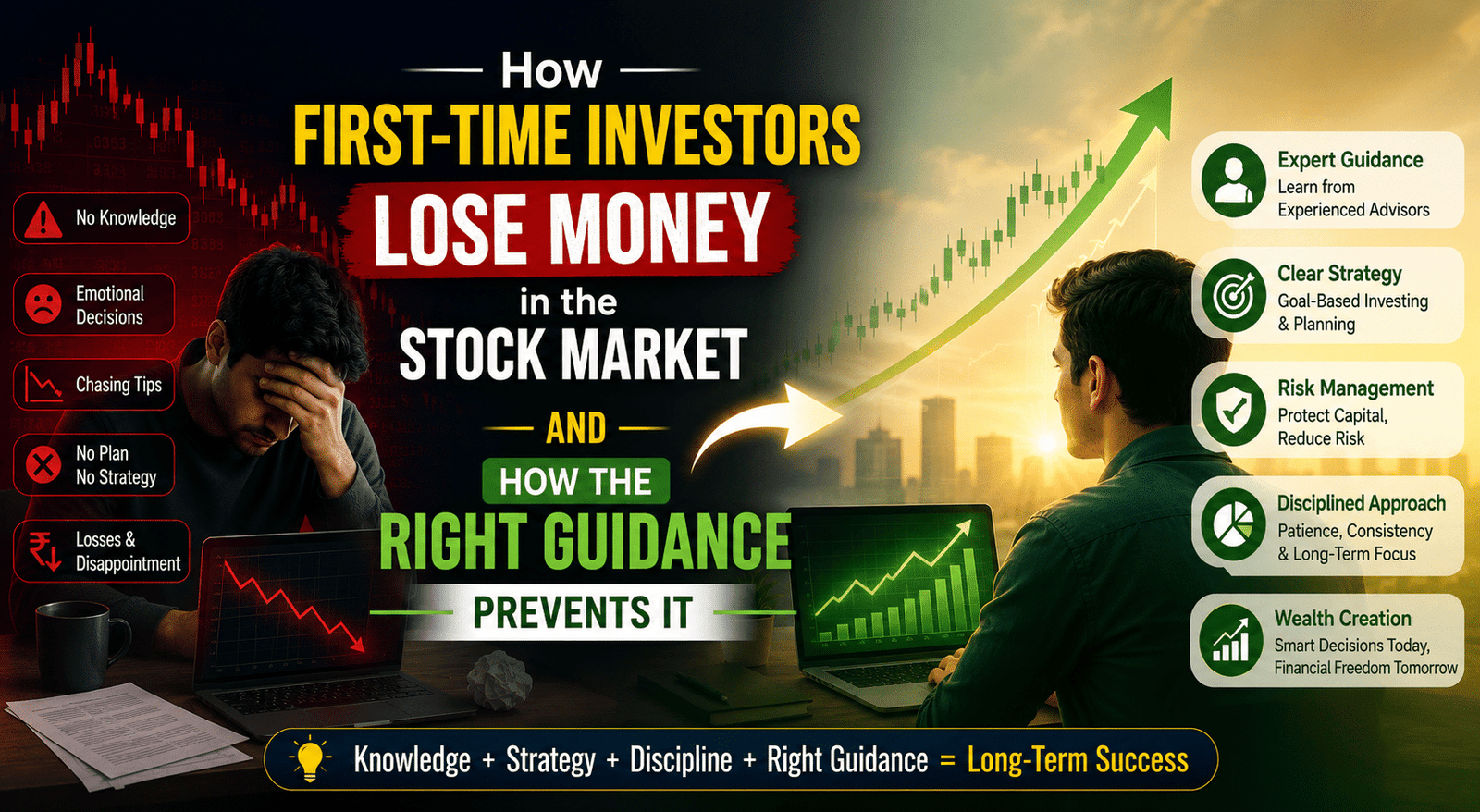
SEBI’s own study on individual traders in the equity derivatives segment found that close to 9 out of 10 retail traders ended FY25 in losses, with the collective damage crossing ₹1 lakh crore for the year. The average trader lost well over ₹1 lakh. These aren’t numbers from a random survey — they come from the regulator’s own analysis of actual trading accounts across India’s top brokers. And the pattern isn’t new. Every study SEBI has published since 2023 has shown the same thing: most first-time investors don’t lose money because the market is rigged against them. They lose money because they enter it without a plan, without the right stock broker for their needs, and without anyone qualified checking their decisions before they hit “buy.”
At Techolic, we’ve spent years watching this play out with real people — someone opens a demat account after seeing a friend’s screenshot of gains, starts trading options within a week, and within three months has wiped out savings that took years to build. This article breaks down exactly where first-time investors go wrong, and how working with the right stock broker, financial advisor, or stock advisory service — used correctly, not interchangeably — closes most of these gaps before they become expensive lessons.
Why Do Most First-Time Investors Lose Money in the Stock Market?
It’s rarely one bad decision. It’s usually a chain of small ones that compound. A first-time investor enters without a defined goal, gets pulled into high-risk instruments before understanding basic ones, follows tips from unverified sources, and reacts emotionally to every red day in the portfolio. Each mistake on its own is recoverable. Stacked together, they’re what turns a ₹50,000 investment into a ₹15,000 account within a year.
The deeper issue is structural: India’s retail investing boom happened faster than retail investor education did. Opening a trading account today takes ten minutes on a mobile app. Understanding what you’re trading takes considerably longer — and most beginners skip that part entirely.
Is Trading Without a Plan the Biggest Mistake New Investors Make?
Yes, and it’s the root cause behind most of the mistakes that follow. A first-time investor without a plan doesn’t know their risk tolerance, their time horizon, or what percentage of their capital they’re willing to lose on a single trade. So they end up making it up as they go — buying because a stock is “trending,” selling in panic when it dips 5%, and averaging down on a falling stock with no exit strategy.
A financial advisor’s first job, before any stock is even discussed, is forcing this clarity: What are you investing for? How much can you afford to lose without it affecting your life? What’s your actual time horizon? Skipping this step is why so many first-time investors treat long-term capital like short-term speculation money.
Why Do First-Time Investors Follow Unverified Stock Tips?
Because unverified tips are everywhere, and they’re designed to sound urgent and credible. SEBI has been actively cracking down on this — in 2025 and 2026 alone, the regulator barred multiple unregistered “finfluencers,” froze accounts linked to pump-and-dump operations on social media, and restricted brokers and mutual funds from associating with anyone giving stock recommendations without proper registration. SEBI even restricted financial educators from referencing live stock prices, requiring a three-month lag specifically to stop real-time tips being disguised as “education.”
Despite this, WhatsApp groups and Telegram channels promising “sure-shot multibaggers” continue to pull in first-time investors, precisely because they don’t yet know what a genuine stock advisory service looks like versus an unregistered one running a pump-and-dump scheme. The difference matters — a SEBI-registered advisory service is accountable for its recommendations and bound by disclosure norms. An anonymous tip in a Telegram group is accountable to no one, and by the time you’re acting on it, the person sharing it has often already sold into the rally they created.
Does Trading Through the Wrong Stock Broker Increase Losses?
It doesn’t cause losses directly, but it removes the guardrails that could have prevented them. Some discount brokers are built purely for execution — fast order placement, low brokerage, minimal friction. That’s exactly what an experienced trader wants. But a first-time investor using the same platform, with no research desk, no risk warnings beyond the mandatory disclaimers, and no one to call before making an impulsive trade, is operating without any safety net.
This is where the right stock broker relationship matters. A broker that offers research support, sector-level insights, and genuine investor education — rather than just an order execution screen — gives a first-time investor something to lean on before a decision, not just after a loss.
What Happens When Investors Skip Financial Advisor Guidance?
They end up making portfolio-level mistakes that have nothing to do with picking the “wrong” stock and everything to do with structure. Common patterns we see: no asset allocation between equity, debt, and other instruments; overexposure to a single sector because it performed well recently; no tax planning around capital gains; and no rebalancing as goals or life circumstances change.
A financial advisor isn’t there to predict which stock goes up next. Their value is in the boring, unglamorous work — making sure your portfolio matches your actual financial goals, that you’re not taking risk you can’t afford, and that your money is working toward something specific rather than just floating in the market hoping for the best.
Why Do Beginners Jump Into F&O Trading Too Early?
Because it looks like a faster way to the same destination — and the marketing around it rarely mentions the odds. SEBI’s regulator-mandated disclosure, now shown at login on every broker platform, states plainly that roughly 9 out of 10 individual traders in the F&O segment lost money in recent years. Options, in particular, feel deceptively simple — a small premium, a directional bet, a potentially large payout. What gets lost is that most retail traders are on the losing side of trades against institutional players and proprietary desks with far superior data, speed, and risk management systems.
First-time investors rarely have the capital cushion, the technical understanding of implied volatility and time decay, or the discipline to cut losses quickly that F&O trading demands. It’s not that derivatives are inherently bad — it’s that they’re the wrong starting point for someone who hasn’t yet built a foundation in equity investing.
Is Emotional Investing Costing You More Than You Think?
Almost certainly, and it’s the hardest mistake to see in yourself while it’s happening. Panic-selling during a correction, chasing a stock after it’s already rallied 30%, refusing to book a loss because “it’ll come back” — these are decisions driven by fear and hope, not analysis. The market doesn’t care about either.
This is precisely why professional guidance matters most during volatile periods, not calm ones. A financial advisor or a genuine stock advisory service provides a second opinion at the exact moment emotion is most likely to override judgment — which is often the difference between a temporary paper loss and a permanently realized one.
How Does the Right Guidance Prevent These Losses?
None of this means a first-time investor needs to hire three separate professionals before buying their first share. It means understanding what each type of guidance actually does, and using the one — or combination — that fits where you are in your investing journey.
What Role Does a Stock Broker Play Beyond Just Execution?
A stock broker gives you market access — the ability to actually place trades, hold securities in a demat account, and track your portfolio. But the better brokers go further, offering research reports, educational content, and risk disclosures that help a first-time investor understand what they’re buying before they buy it, not after. When we work with clients at Techolic, this is often the first relationship we build — because the broker you choose shapes every trade you’re able to make afterward, including how easy or hard it is to make an uninformed one.
How Does a Financial Advisor Help You Avoid Costly Mistakes?
A financial advisor works at the portfolio level, not the trade level. They help set realistic goals, decide how much exposure to equity versus debt makes sense for your age and risk appetite, and course-correct when life changes — a new job, a home loan, a child’s education fund — shift your priorities. This is the guidance that prevents the structural mistakes: over concentration, no rebalancing, and treating every rupee in the market the same way regardless of what it’s meant for.
What Should You Look for in a Genuine Stock Advisory Service?
The single most important check is SEBI registration — a genuine stock advisory service will readily share its registration details and is bound by disclosure and conduct rules that protect you. Beyond that, look for advisory services that explain their reasoning rather than just issuing buy/sell calls, that disclose their track record honestly including the misses, and that never promise guaranteed or assured returns — a claim that itself is a red flag under SEBI’s current rules. At Techolic, our approach has always been to explain the “why” behind every recommendation, because an investor who understands the reasoning makes better decisions even when we’re not in the room.
Common Mistakes First-Time Investors Should Watch For
No written investment goal — Investing without knowing what the money is for makes every market dip feel like a crisis instead of a normal fluctuation.
Treating F&O as a shortcut — Jumping into derivatives before understanding equity basics is one of the fastest ways to erode capital, as SEBI’s own data consistently shows.
Following anonymous tips — Acting on unverified stock recommendations from social media or forwarded messages, without checking if the source is SEBI-registered.
Ignoring diversification — Putting most capital into one stock or sector because it recently performed well, rather than spreading risk deliberately.
Reacting instead of reviewing — Making buy or sell decisions based on a single day’s price movement rather than reviewing the underlying reason for holding the investment.
Skipping the research desk — Using a stock broker purely for its low brokerage while ignoring the research and education tools that could prevent an uninformed trade.
No exit plan — Entering a trade without deciding, in advance, at what point you’ll book profits or cut losses.
Frequently Asked Questions
Do I need a financial advisor if I’m just starting to invest with a small amount?
Not necessarily a dedicated one-on-one advisor from day one, but you do need the equivalent guidance — a clear goal, a basic understanding of asset allocation, and a stock broker that offers educational resources. As your portfolio grows and your financial life gets more complex, formal Investment advisor guidance becomes more valuable.
How can I check if a stock advisory service is genuine and SEBI-registered?
You can verify registration details directly on SEBI’s official website using the advisor’s name or registration number. A genuine service will never hesitate to share this information, and it will never guarantee fixed or assured returns on stock recommendations.
Is it possible to make money in F&O as a first-time investor?
It’s possible but statistically unlikely — SEBI’s own studies have repeatedly shown that the vast majority of individual traders in the derivatives segment end up with net losses. For most first-time investors, building a foundation in equity and mutual fund investing first makes far more sense than starting with derivatives.
What’s the difference between a stock broker and a stock advisory service?
A stock broker gives you the platform to execute trades and hold your investments. A stock advisory service provides research-backed recommendations on what to buy or sell. Some firms offer both under one roof, but they’re functionally different — one is about access, the other is about guidance.
How much does professional financial guidance typically cost in India?
It varies widely — some financial advisors charge a flat annual fee, others charge a percentage of assets under management, and some stock advisory services work on a subscription model. What matters more than the exact number is transparency: any professional worth working with will explain their fee structure clearly before you commit.